
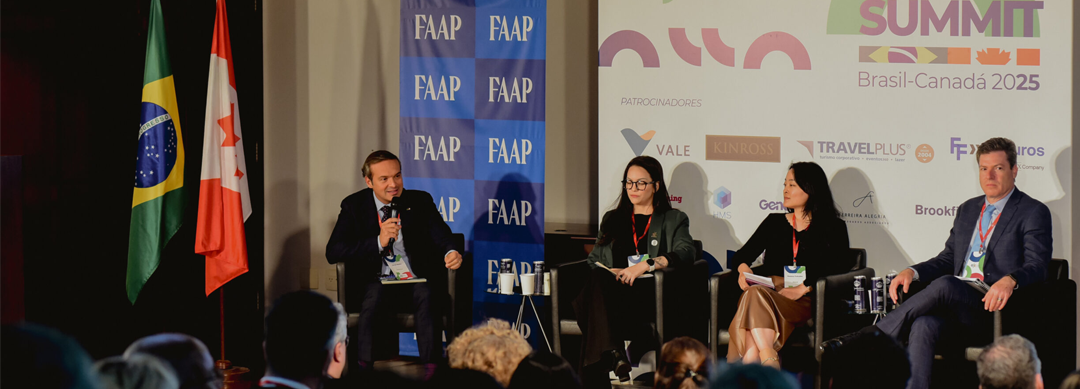
Panel at a CCBC event shows that environmental responsibility and governance remain key to corporate competitiveness
By Pedro Augusto
The debate around environmental, social, and governance (ESG) practices has taken on new contours amid recent global crises involving geopolitical conflicts, tariff pressures, and increasingly frequent climate-related events. In this context, taking action to reduce environmental damage and implement sustainable practices is essential for companies seeking to remain competitive.
This discussion was further explored during one of the panels at the Brazil-Canada Summit, hosted by the Chamber of Commerce Brazil-Canada (CCBC). Executives from different sectors shared insights on climate risk, international metrics, corporate culture, and practical applications of sustainability.
“The value of analyzing environmental risks is extremely powerful for business development,” said Sergio Myssior, coordinator of CCBC’s Compliance and ESG Committee and CEO of the MYR Group. He noted that companies adopting corporate policies to preserve the surrounding ecosystem tend to be more valued and competitive in the market. “The ESG agenda is directly connected to business operations,” he added.
This connection exists because, according to him, sustainable practices used as governance tools help organizations anticipate environmental risks that affect society, strengthen their image within the community, and reduce negative impacts on productivity — a global trend driven by climate change. “Climate events can disrupt supply chains and even lead to shortages of essential inputs.”
During the event, Rosane Fukuoka, Technical Director at Mitsidi, highlighted how geopolitical tensions affect Brazilian supply chains. She recalled that the 50% surcharge imposed by the United States on Brazilian products in July caused an 80% drop in exports and the loss of 15,000 jobs in São Paulo alone, according to a study conducted by her company.
This loss of international market share means that only the most productive companies remain competitive. To thrive, they must rely on highly skilled professionals who increasingly choose where they want to work. “Young people no longer want to work for conventional companies; they want to be in organizations aligned with their values,” Rosane noted, emphasizing the importance of connecting corporate reputation with ESG policies.
For Giovanna Cappellano, from Concepta Ingredients, ESG begins with corporate culture. “Responsibility, ethics, and morality are integral to business; when you work ethically, you’re already beginning to adopt ESG practices,” she said. The executive also shared internal data illustrating the benefits of integrating governance and sustainability. Since implementing ESG-focused initiatives, Concepta has recorded up to a 20% increase in sales, a reduction of up to 30% in financial risks, and a 57% decrease in employee turnover. “ESG is not a temporary trend; it’s already part of everyday conversations — with Human Resources, with communities, in environmental matters, and in governance.”
A tool to support companies on their ESG journey
During the panel, Sergio Myssior from CCBC’s Compliance and ESG Committee and the MYR Group also highlighted an initiative aimed at helping companies adopt sustainable practices. He explained that the ESG Calculator — developed by ESG Solutions and made available to Chamber members — is designed to guide organizations in assessing their sustainability maturity.
“With this tool, we show that the transition toward governance with these dimensions is naturally long, but it doesn’t need to be costly or complex; it can be accessible even for small and medium-sized businesses.”
According to him, the calculator supports the diagnostic process and helps companies identify their key areas for improvement, reinforcing that the ESG agenda requires continuity and evolution.
CCBC’s presence at COP 30
The Brazil-Canada Summit, hosted by the Chamber of Commerce Brazil-Canada, took place shortly before the 30th United Nations Climate Change Conference (COP 30), held in Belém, Pará, this November. The global event, which brought together leaders and business representatives from around the world to discuss and negotiate climate action, also featured participation from CCBC. Chamber representatives attended the conference to support Brazilian and Canadian companies such as Mitsidi, Cescon Barrieu, OPTEL Group, and BRP in environmental discussions.
CCBC organized four panels in the Blue Zone, in partnership with the Bem Ambiental Institute (IBAM): Sustainable Fuel Production – Chemical Innovations for the Climate; Environmental Health and Sustainable Mobility – Anticipating Risks and Protecting Communities; Industrial Decarbonization – Innovation in Chemical Processes; and Sustainable Urban Planning and Low-Carbon Cities.
In addition, the Chamber took part in an event hosted by the Embassy of Canada on Responsible Business Conduct (RBC), represented by its director of members and business, Daniella Leite, where the importance of bilateral cooperation and awareness across supply chains was emphasized.
CCBC’s members participating in COP 30 focused on themes such as energy transition and sustainable development. The institution also supported MYR Group initiatives through the Road to COP30 project, which brought representatives from the company and IBAM on a journey through Brazil’s biomes — from Belo Horizonte to Pará, host of the Conference — traveling by motorhome.
Together with IBAM, the MYR Group also took part in the conference at the Smart Cities Pavilion, strengthening the environmental agenda for the implementation of ESG-oriented solutions in municipalities.