
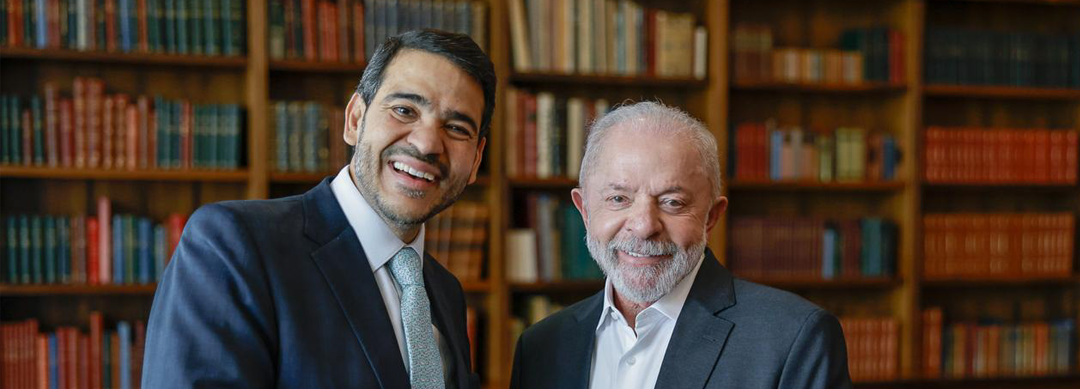
By Fernanda Arbex and Igor Andrade, Partners at Innova Public Affairs*
The recent nomination of the Attorney General of Brazil, Jorge Messias, to the Supreme Federal Court (STF) seat vacated by the retirement of Justice Luís Roberto Barroso confirms a familiar pattern in President Luiz Inácio Lula da Silva’s appointments to the country’s highest court: the selection of individuals of personal trust, rather than choices guided by political or symbolic pressures.
Messias is a career public servant within the Office of the Attorney General, where he has served as a National Treasury Attorney since 2007. His trajectory has been marked by a long-standing connection to the Workers’ Party (PT) and to Lula himself. He became nationally known in 2016, during the impeachment crisis, when then-president Dilma Rousseff tasked him with delivering Lula’s appointment letter as Chief of Staff — an episode that became public after a recorded phone call between the two was released. Today, in addition to serving as Attorney General, Messias also reflects a profile Lula has sought to reconnect with: he is an evangelical Christian, a group with which the government maintains strategic dialogue within the electoral sphere.
Although widely expected within the Executive Branch, Messias’s nomination generated significant friction with the Federal Senate, which is responsible for vetting and approving the appointment. A majority of senators, led by Senate President Davi Alcolumbre (UNIÃO/AP), had been working in favor of nominating Senator Rodrigo Pacheco (PSD/MG), the former Senate president. Pacheco enjoyed strong support from his peers and the sympathies of several current Supreme Court justices. Even so, Lula resisted the pressure, opting once again for the criterion of direct trust — the same logic that guided his nominations of Cristiano Zanin and Flávio Dino.
Alcolumbre’s dissatisfaction surfaced almost immediately. On the same day Messias’s nomination was confirmed, he announced a vote on a bill granting special retirement status to community health workers, a proposal with an estimated fiscal impact of up to R$ 200 billion. The move was interpreted as a direct response to Lula’s decision, highlighting the institutional pressure mechanisms available to the Senate, even though it virtually never rejects Supreme Court nominations (something that has not happened since the 19th century).
Another sensitive point was Lula’s decision not to seriously consider appointing a woman to the seat. Despite campaign rhetoric in 2022 emphasizing gender parity, the choice of Messias maintained the recent pattern of predominantly male appointments to the Court. To mitigate part of the criticism — particularly from the left — the president indicated he may appoint a woman to replace Messias as head of the Attorney General’s Office. Still, this does not change the fact that the STF will remain, for now, overwhelmingly male.
Despite the dissatisfaction among a significant portion of the Senate, Messias’s confirmation is still considered highly likely. The process, however, is expected to take longer, with the nominee undergoing a period of active political outreach. The expectation is that the proceedings will occur with some distancing from the presidential palace, forcing Messias to build support autonomously among senators — a dynamic that reflects both discomfort with the choice and the institutional tradition of ultimately approving presidential nominees to the Court.
The nomination reinforces the President’s role in shaping the direction of the Court but also exposes the limits of Brazil’s coalition presidentialism. At a moment when the government is trying to consolidate its base and recalibrate its political strategy ahead of 2026, the episode underscores that presidential trust in a nominee does not eliminate the political costs of the choice — particularly when it clashes with established interests in the Legislature.
*This text does not necessarily reflect the opinion of the CCBC and is the sole responsibility of the author of this content.