Governments intensify dialogue as the CCBC works to foster business between the two countries, amid expectations surrounding the signing of the Mercosur agreement
By Marcelo Picolo
The relationship between Brazil and Canada is currently marked by two clear signals. On the one hand, bilateral trade figures continue to break records. On the other, there remains a strong expectation that there is still significant room for growth, driven by the free trade agreement between Canada and Mercosur, which has been under negotiation since 2018 and regained momentum in 2025 and this year.
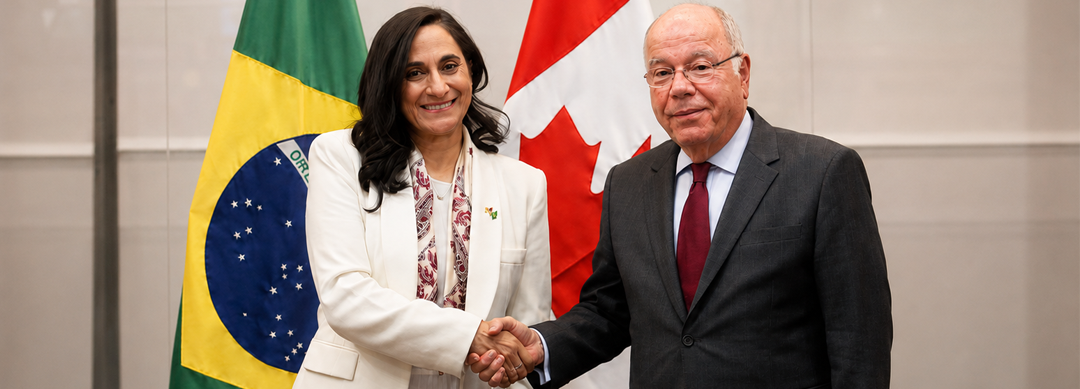
Discussions between the two countries have intensified. In July, Canadian Foreign Minister Anita Anand visited São Paulo for the 5th Brazil-Canada Strategic Partnership Dialogue, where she met with Brazilian Foreign Minister Mauro Vieira. The meeting marked 85 years of formal diplomatic relations between the two nations, a relationship that dates back to Canada’s first trade mission to Brazil in 1866.
The recent visit resulted in concrete commitments, including a US$125 million investment by FinDev Canada in sustainable infrastructure and sustainable aviation fuel projects in Brazil, an operational plan for the memorandum on combating wildfires, a new Mutual Customs Assistance Agreement and a memorandum of technical cooperation in the healthcare sector.
Current trade figures between Brazil and Canada confirm that there is substantial momentum for further growth in the coming months. According to Quick Trade Facts, a recent trade balance study produced by the Chamber of Commerce Brazil-Canada (CCBC) covering the second quarter of 2026, Brazilian exports to Canada rose 8% year over year, reaching US$3.67 billion, while Brazilian imports of Canadian products increased by 31%, totaling US$1.8 billion.
Brazil maintained a positive trade balance of US$1.88 billion, while total trade between the two countries grew by 15% during the period. The appreciation of the Brazilian real also supported trade flows: the Brazilian currency closed the first half of the year at R$5.13 per Canadian dollar, a stronger level than during the same period in 2025.
Sectors in focus: mining, agribusiness, education and technology
Mining remains the most visible driver of the trade relationship. Gold bullion alone accounted for more than 56% of everything Brazil exported to Canada in the second quarter, with a 52% increase in value compared with 2025, directly reflecting the global search for assets perceived as safer amid international instability. However, the most promising chapter may only be beginning: rare earth elements and critical minerals.
Brazil holds the world’s second-largest reserves of these elements, with approximately 21 million tonnes, or 23% of the global total, according to the Brazilian Mining Institute. Against this backdrop, Canadian companies are already competing for a foothold in this emerging market alongside Australian and British groups, with projects such as that of mining company Resouro, which is seeking funding to advance a US$160 million project in Brazil. In more established trade flows, Canada is also a relevant destination for Brazilian ferroniobium and nickel ores.
Agribusiness clearly illustrates the complementary nature of the relationship: Brazil sells food, while Canada supplies the inputs that support this production.
According to projections by international relations experts, a potential Mercosur-Canada agreement could open up an additional market worth more than US$1 billion for Brazilian agribusiness, expanding access to a market of tens of millions of consumers with strong purchasing power. Animal proteins would be among the key opportunities, provided Canadian sanitary requirements are met. On the import side, fertilizers — particularly potassium chloride — account for more than half of everything Brazil purchases from Canada, representing 52.3% of imports in the second quarter of 2026, following a 48% increase in value compared with the previous year. Canada is the world’s second-largest fertilizer exporter, while Brazil is the largest global importer of the product.
Cooperation in education is also gaining momentum. Scholarships such as ELAP (Emerging Leaders in the Americas Program) continue to fund exchanges for Brazilian students at Canadian universities in fields including engineering, biology, law, international relations and agronomy.
At the institutional level, the Federal University of Pará (UFPA) signed a cooperation agreement with the Université du Québec à Trois-Rivières for an academic exchange program, while Instituto Atlântico established partnerships with International Business University and the Northern Alberta Institute of Technology (NAIT) focused on talent development and the joint development of emerging technologies.
On the technology front, Canada is currently one of the leading suppliers of medical equipment, software and clean energy solutions to the Brazilian market. The second quarter of 2026 reinforced this role, with imports including turbojets and turbines, helicopters, tractors and agricultural equipment.
Financial cooperation further strengthens this front. In July alone, FinDev Canada announced US$58 million in financing for a sustainable aviation fuel biorefinery in Bahia and a US$50 million package to modernize power distribution in Maranhão. A survey conducted by the Northeast Integration Council in partnership with ApexBrasil also identified 534 business opportunities in Canada for Brazilian exporters of machinery, transportation equipment and food products. Despite a 17% decline in Canadian direct investment in Brazil in 2024, the country remains Brazil’s 13th-largest foreign investor, with particular relevance in the financial, extractive industries and real estate sectors.
Mercosur-Canada agreement: expectations and caution
It is against this backdrop of already robust trade that negotiations for the free trade agreement between Mercosur and Canada are moving forward. After resuming in 2025 amid the United States’ tariff offensive, negotiations gained momentum in 2026. The 10th Negotiating Round, held in Toronto in May, moved five chapters of the agreement — including rules of origin and intellectual property — into the final stage of discussions.
The Brazilian government estimates that a significant portion of the agreement has already been concluded, with the stated goal of ideally completing negotiations before the end of 2026, according to Canadian Foreign Minister Anita Anand.
The most sensitive issues remain the tariff liberalization schedule and rules of origin — topics likely to encounter resistance from sectors such as Canadian agriculture, as well as coordination challenges among Mercosur countries, whose economies operate at different paces and maintain distinct trade alliances.
“We remain hopeful that the agreement will continue to move forward,” said Hilton Nascimento, president of the Chamber of Commerce Brasil-Canada (CCBC). “We also hope it will include mutual cooperation agreements in mining, education, technology and agribusiness; there are many opportunities in these sectors,” he added.