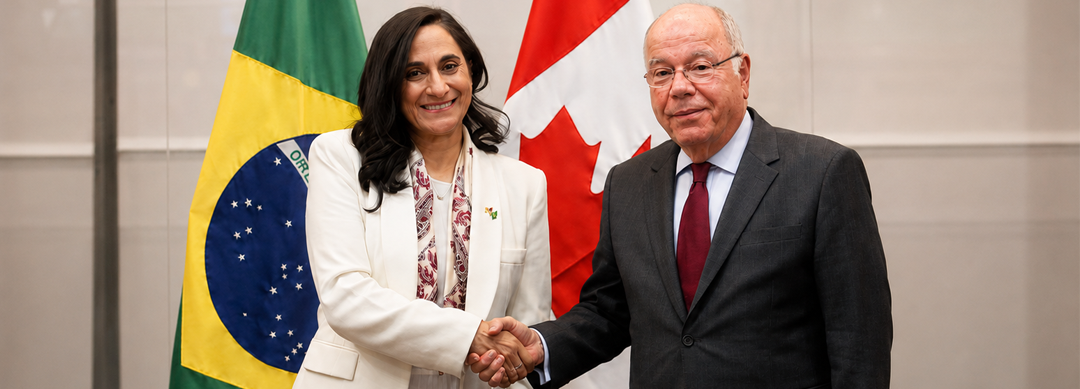
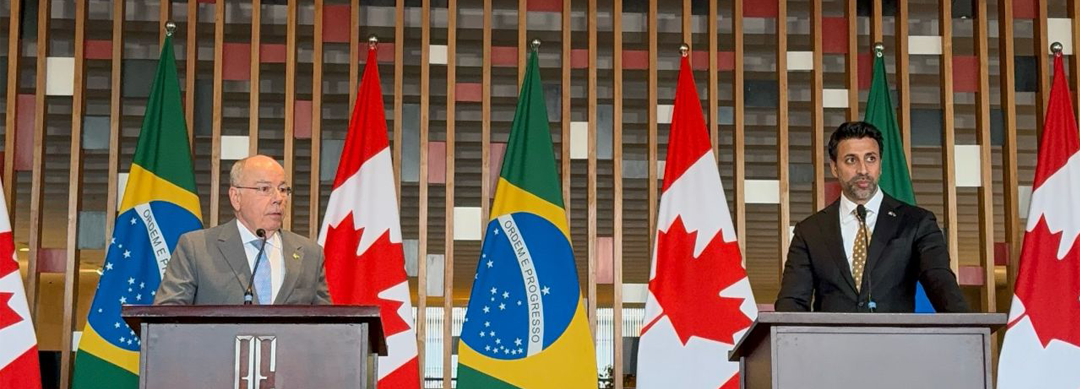
Visit of Minister Maninder Sidhu to Brazil also signals progress in talks and opportunities for both countries
By Pedro Augusto
Negotiations for a free trade agreement between Mercosur and Canada have been officially resumed. The announcement was made by Brazil’s Foreign Minister Mauro Vieira during a meeting with Canada’s Minister of International Trade, Maninder Sidhu, at the Itamaraty Palace in late August, in Brasília. The progress comes at a time when recent tariffs imposed by the United States reposition the negotiation as a strategic alternative for both blocs.
“This will be a timely and strategic step that responds to the current moment of the international economy and demonstrates the willingness to seek greater integration, competitiveness, and opportunities for our productive sectors,” said Vieira.
Sidhu’s visit to Brazil reinforced the movement to strengthen ties with South America. In addition to the meeting at Itamaraty, the Canadian minister attended the Brazil–Canada Business Forum, held at the Federation of Industries of the State of São Paulo (FIESP), in São Paulo’s capital.
“Canada wants to be Brazilians’ preferred partner in trade and investment, and we are together as reliable trade allies to further strengthen this relationship,” said Minister Sidhu during the Brazil–Canada Business Forum at FIESP, highlighting Brazil’s leading role within Mercosur.
Talks to intensify trade relations between South American countries and Canada formally began in 2018, with seven rounds held through 2019, covering topics such as services, investments, and intellectual property. The process was interrupted in 2020 by the pandemic and, despite a modest resumption in 2023, little progress was made. Now, with the repositioning of global value chains, dialogue is once again at the center of the agenda.
In 2024, total trade between Mercosur and Canada reached CAD 15.8 billion (approx. BRL 64 billion at the current rate), with strong complementarities between the blocs: Mercosur is competitive in agribusiness and industrial commodities, while Canada stands out in services, technology, and high value-added goods.
Brazil, Mercosur’s main partner, recorded bilateral trade of CAD 12.5 billion (BRL 50.7 billion) with Canada in 2024. Brazilian exports totaled CAD 8.71 billion (BRL 35.3 billion), led by bullion doré (CAD 2.49 bn / BRL 10.1 bn), calcined alumina (CAD 2.23 bn / BRL 9.1 bn), and cane sugar (CAD 895 mn / BRL 3.6 bn). On the Canadian side, exports reached CAD 3.84 billion (BRL 15.5 billion), driven by potassium chloride (CAD 1.72 bn / BRL 6.9 bn) and turbojets (CAD 189 mn / BRL 761 mn).
The FIESP meeting was also attended by company representatives, government officials, and Hilton Nascimento, President and Director of the Chamber of Commerce Brazil–Canada (CCBC), who highlighted the potential for expanding Canada’s relations with Mercosur. “The Mercosur–Canada agreement represents a historic opportunity to bring our markets closer together and generate good business for everyone,” said Nascimento.
Expected Benefits
According to the National Confederation of Industry (CNI), such an agreement could increase Brazil’s share of world trade from 8% to 11%, with gains in sectors such as meat, sugar, coffee, fruits, ethanol, pulp, automobiles, and machinery. For Canada, the treaty would help reduce its dependence on the United States, which currently accounts for 76% of Canadian exports, while also granting preferential access to a market of more than 270 million consumers in Mercosur.
Strategic sectors such as clean energy, biofuels, infrastructure, mining, fertilizers, and technology stand out as priority areas for cooperation. In addition, the agreement is expected to boost investment and services with greater legal certainty, with potential in finance, telecommunications, transportation, and government procurement.
“The Brazil–Canada Chamber of Commerce acts as a bridge between investors and companies in both countries; we are confident that resuming negotiations with Mercosur will generate more investment and technology, further strengthening the relationship that already exists between Canadians and Brazilians,” added Nascimento.