CAM-CCBC Congress held last month in São Paulo brought together leading experts from more than 40 countries; use of technology without parties’ awareness and unclear drafting in M&A contracts are among the sector’s key discussion points
By Pedro Augusto and Marcelo Picolo
International arbitration is undergoing a period of transformation. The advancement of Artificial Intelligence (AI), the increasing complexity of disputes, and the need to preserve trust among parties pose significant challenges to the field. Likewise, imprecise or incomplete drafting in merger and acquisition (M&A) agreements and the potential for public administration intervention in arbitration proceedings are central issues in this ongoing landscape of debate and continuous improvement.
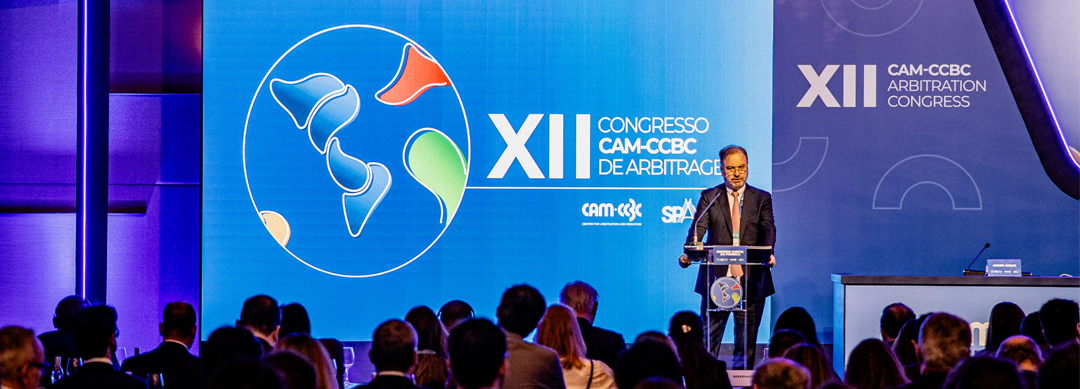
These themes were widely examined during the 12th Arbitration Congress of the Center for Arbitration and Mediation of the Chamber of Commerce Brazil-Canada (CAM-CCBC), one of the most important events in the field in Latin America, which gathered around 680 participants this year. The event took place in São Paulo at the end of last month, bringing together leading arbitration experts from various Brazilian states and more than 40 countries.
“For arbitration to remain a viable means of dispute resolution, it must offer what the parties seek: fair outcomes, with decisions made by qualified and responsible professionals,” said Andrea Bjorklund, Full Professor at McGill University and holder of the L. Yves Fortier Chair in International Arbitration, with experience in the public sector, private practice, and arbitral institutions.
The challenges faced by the sector today are at the center of contemporary debates on the effectiveness and legitimacy of arbitration. These challenges can be seen, for example, in how contractual clauses are drafted, in the intervention of public administration in arbitral proceedings, and in the ethical and properly disclosed use of artificial intelligence in preparing and systematizing procedural acts.
Among experts, there is consensus that the way contracts are drafted is the first step toward ensuring predictability and reducing disputes. In merger and acquisition (M&A) operations, ambiguous clauses, poorly defined timelines, and inaccurate translations of foreign terms or expressions are among the main causes of disagreements and conflicts in corporate law.
“These are issues that can be solved—or at least mitigated—through sound contract-drafting techniques. When the document has poorly drawn contours, the level of uncertainty rises and disputes naturally emerge,” explained André Abbud, from BMA Advogados, who specializes in complex national and international arbitral and judicial disputes.
Public Administration
Arbitration challenges also extend to the intervention of public administration in disputes, especially in cases with major economic and social impact. State interference is exercised through the intervenção anômala, a mechanism that allows public administration to participate in proceedings in which it does not have a direct legal interest. In principle, its mere expression of intent to intervene is sufficient, given that such proceedings may affect the economic well-being of society.
Recent experiences—such as the arbitrations involving the Viracopos Airport concession (in Campinas, São Paulo), Telefônica, and MSVia (Monitoramento Pantanal)—illustrate the State’s growing institutional maturity when participating in arbitral processes.
All three cases involved the economic-financial rebalancing of concession contracts. The public administration, represented by the federal government, intervened to ensure that arbitral decisions considered the economic impact on public policies and contracts.
The public agent’s role in these examples was recognized as significant and essential for resolving the disputes. The intervention helped clarify complex issues and inform the tribunal about implications that may not have been evident based solely on the parties’ submissions.
“The role of the interveniente anômalo (the State), as seen in the Viracopos and Telefônica cases, is precisely to clarify facts and legal issues, submit briefs, and provide documents,” explained Cristina Bichel Leitão, State Attorney of Paraná and member of the State Attorney General’s Office (PGE/PR). “It is not a party and therefore cannot produce evidence, even though there are differing views on this point,” she added.
However, according to Paula Butti Cardoso, from the Office of the Attorney General of the Union (AGU), the Viracopos case stands out because “the federal government took a more active role, bringing forward relevant factual and legal information that contributed to shaping the tribunal’s understanding.”
Artificial Intelligence
Another topic requiring close attention is the use of artificial intelligence (AI) in arbitral proceedings. AI has the potential to streamline document review and assist in organizing and systematizing evidence, but specialists warn that no tool replaces human judgment. “If arbitrators or experts decide to use artificial intelligence, they must disclose this to the parties and give them the opportunity to comment on the use of the specific tool,” said Thaís Chebatt, an infrastructure projects specialist at Pinheiro Neto Advogados.
According to Nikolaus Pitkowitz, President of the Vienna International Arbitral Centre (VIAC), caution is essential when employing AI in arbitration. “We cannot explain the algorithms, but we must monitor how they are used and how they behave so that we avoid surprises that could compromise ethics in arbitral proceedings.”
Among other topics that sparked strong reactions at the congress was the strengthening of mechanisms aimed at preventing disputes—such as Dispute Boards for resolving issues in long-term contracts, and independent legal opinions (expert legal opinions). Discussions among academics from around the globe highlighted a new stage of maturity for arbitration and other methods of dispute resolution.
“In this dynamic and uncertain context, private conflict management must go further, taking on a leading role in risk prevention and in the pursuit of increasingly effective and innovative solutions,” said Rodrigo Garcia da Fonseca, President of CAM-CCBC.