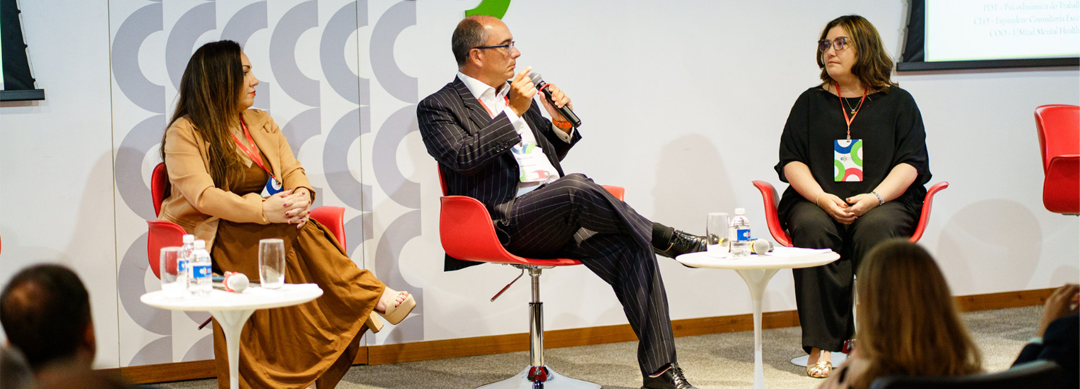
Privacy Day, an event held at the Chamber, highlighted global challenges in child protection online and the need for swift regulatory and educational responses
By Pedro Augusto
In an increasingly technological world, where children and adolescents connect from an early age to study, play, and socialize, cybersecurity has become a fundamental pillar in safeguarding rights. The rapid expansion of access to new platforms, digital tools, and social networks has also amplified risks such as cyberbullying, exposure to violent and sexually explicit content, and dangerous online interactions.
Through its Compliance & ESG and Technology & Innovation Committees, the Chamber of Commerce Brazil-Canada (CCBC), with support from the National Association of Data Privacy Professionals (APDADOS), brought this discussion into its institutional space. Beyond its business mission, the Chamber also fulfills an important social role as a representative entity.
Earlier this month, the CCBC hosted the 3rd edition of Privacy Day, an annual event held in São Paulo created specifically to address the most current issues in digital privacy.
Data from the Childlight Global Child Safety Institute, hosted by the University of Edinburgh, indicate that the current scenario has already reached alarming proportions: one in eight children — approximately 302 million young people — was a victim in the past year of online sexual exploitation or abuse, including non-consensual exposure, sharing, and solicitation of sexually explicit images and videos.
In addition, according to the Global Child Online Safety Index released by the DQ Institute, nearly two-thirds of children aged 8 to 12 are exposed to one or more types of cyber risk, such as cyberbullying, online threats, or contact with strangers requesting offline meetings.
For Paulo Perrotti, coordinator of the CCBC Compliance & ESG Committee and moderator of the event, the debate on data protection and the safety of children and adolescents in the digital environment must move beyond the legal sphere and reach parents, family members, and guardians, who play a central role in preventing harm and guiding young people.
“We at the CCBC and APDADOS are fulfilling our social role, which is to raise awareness and build capacity within society so that our companies, our professions, and our work can be properly guided with respect to data protection and the protection of children,” he stated.
Roblox and Other Online Games
In one of the event’s panels, experts focused on children in online gaming environments, using recent episodes involving the game Roblox — highly popular among young users — as a case study. “Every button, avatar, and skin is designed with the purpose of capturing players’ attention; that is when childhood becomes more inclined to consume the product,” said Mirian Lima, a legal scholar and researcher in law, innovation, and society.
The appeal of the game and its commercial features expanded communication channels such as chat functions available on the platform. The company then decided to limit communication between different age groups as an attempt to reduce risks of harassment and grooming.
However, in recent months, children organized virtual protests within the game environment itself following Roblox’s initiative to restrict access in order to curb online crimes. The in-game mobilization gained traction on social media and sparked discussions about digital autonomy, misinformation, and perceptions of safety on platforms.
According to Mirian, there is a structural imbalance in the relationship between children and digital platforms. “Children themselves do not have the capacity to understand what may lie behind the online universe; that responsibility belongs to adults, society, and the State,” she said.
Paradoxically, although the measure aimed to enhance protection for younger users, experts at the panel emphasized that gaming environments continue to expose children to significant risks, including contact with strangers, inappropriate content, and attempts at exploitation. Cases of minors groomed by adults, culminating in online exposure, have led to investigations of platforms for alleged failures in child protection in Brazil.
Regarding prevention and data protection, the experts gathered at the event advocated for aligning the proposed Digital Statute of the Child and Adolescent (ECA Digital) with the General Data Protection Law (LGPD), which came into force in September 2020 to safeguard fundamental rights to freedom and privacy in both manual and digital environments. This alignment was described as a crucial step toward establishing a more robust and specific regulatory framework for the digital environment. “When we talk about cybersecurity, we realize that many parents still lack sufficient knowledge,” said Silvia Brunelli, lawyer and head of government relations at APDADOS.
Additionally, complementary strategies that parents and guardians can adopt were highlighted, including the use of parental control tools, the establishment of clear limits on screen time and types of content, active monitoring of children’s online interactions, and ongoing education on digital security and data privacy. For Hélio Moraes, partner at PK Advogados and co-coordinator of the Chamber’s Technology Committee, this is the time to create educational “micro-learning modules” for the digital environment. “The environment must be regulated; our physical identity is now embedded in the digital sphere,” he concluded.