Economic model expanded access to global markets, strengthened the business environment and attracted investments
By Pedro Augusto
As Canada celebrates the 159th anniversary of the Canadian Confederation, the country’s economic trajectory helps explain how it has established itself among the world’s most open economies. Over more than a century and a half, the country has developed a strategy based on free trade, institutional stability and innovation. Today, Canada maintains trade agreements with 51 countries, which together account for around two-thirds of global Gross Domestic Product (GDP), and ranks among the most attractive destinations for investment.
This process has taken place gradually. In recent decades, the country has expanded its network of trade agreements, strengthened its economic institutions and invested in higher value-added sectors. The result has been a more diversified economy, where natural resource exports remain relevant while coexisting with greater integration into global production chains.
The results are reflected in economic indicators. According to the State of Trade 2026 report, prepared by Global Affairs Canada, the government body responsible for Canada’s international relations and trade, international commerce accounts for around two-thirds of Canadian economic activity, while exports support approximately one in every five jobs in the country.
Diversification has also become a priority. Although the United States remains Canada’s main trading partner, the country has expanded its presence in other markets. In 2025, around one-third of Canadian exports were destined for countries other than the United States, the highest share recorded in four decades. This growth was driven by trade agreements with the European Union and Indo-Pacific economies, expanding access to these markets.
Structural growth
The business environment is another competitive advantage. In 2025, Canada received US$93 billion in foreign direct investment, according to official data, one of the highest levels recorded in the past decade. The result reflects factors such as political stability, institutional independence and regulatory predictability.
The economy has also undergone a structural transformation. According to the State of Trade 2026 report, natural resources continue to play a significant role, but they are no longer the sole driver of growth. Sectors such as technology, artificial intelligence, critical minerals, clean energy, financial services and biotechnology have gained prominence, expanding the country’s innovation capacity.
The labor market has followed this trend. Skilled immigration policy has become part of Canada’s economic strategy. Each year, according to the Immigration Levels Plan, the country welcomes professionals to meet the demand for specialized labor, address population aging and sustain productivity growth.
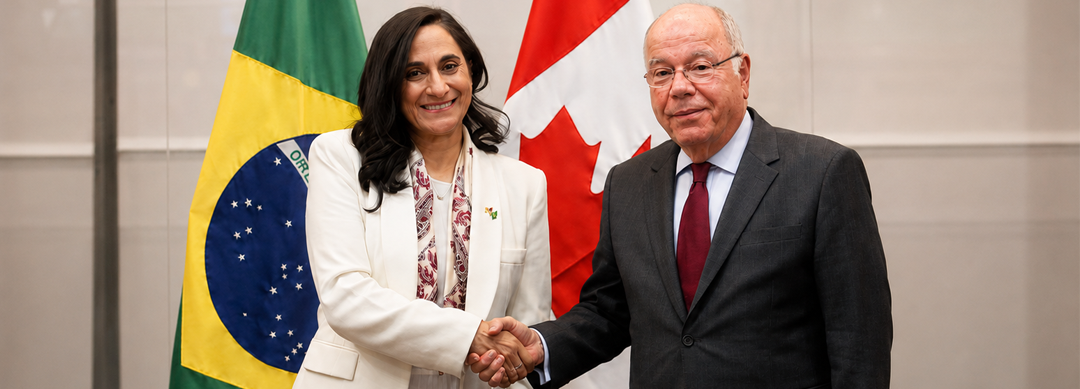
This combination of factors has also strengthened economic ties with Brazil. Bilateral trade has been expanding, driven mainly by minerals, fertilizers, agribusiness products, technology and services. In the first half of this year, trade between the two countries reached US$5.47 billion, a 15% increase compared with the same period last year.
At the same time, Brazilian companies have begun to view Canada as a platform for accessing markets with which the country maintains trade agreements. In an international environment marked by tariff disputes, changes in global production chains and the search for new trading partners, the Canadian model has gained even greater relevance.
Canada Day marks the country’s formation
Celebrated on July 1, Canada Day is the country’s national holiday and commemorates the creation of the Canadian Confederation in 1867. At the time, Ontario, Quebec, Nova Scotia and New Brunswick united to form a single nation.
Across Canadian territory, the date is celebrated with civic ceremonies, festivals, musical performances and family activities. In the capital region of Ottawa-Gatineau, the official program includes concerts, cultural attractions, the national ceremony, recreational areas and the traditional fireworks display, along with events held throughout different parts of the city.