Partnership establishes international cooperation to promote arbitration and mediation and expands presence in Asia
By Pedro Augusto
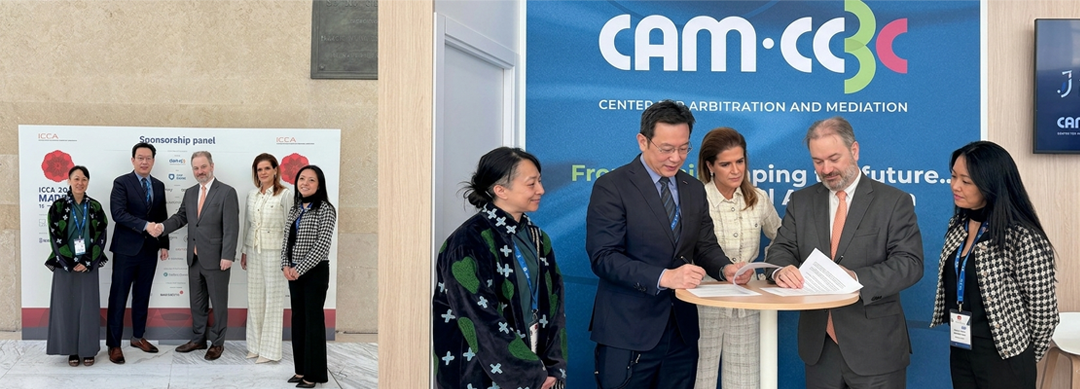
The Center for Arbitration and Mediation of the Chamber of Commerce Brazil-Canada and Maxwell Chambers, headquartered in Singapore and recognized as a leading dispute resolution infrastructure provider, signed a Memorandum of Understanding (MOU) during the ICCA Madrid 2026. The agreement represents a significant step forward in the partnership between the institutions and establishes an innovative model of strategic collaboration between Latin America and Asia.
Two central aspects of the agreement will allow the CAM-CCBC to establish a presence within Maxwell Chambers in Singapore. First, the Brazilian institution will receive priority access to Maxwell Chambers’ international-standard infrastructure, including specialized hearing rooms, workspaces, and technical support for arbitration hearings and mediation sessions conducted under its administration.
The second aspect provides for the establishment of a virtual presence for the CAM-CCBC in Singapore, promoting greater institutional integration and facilitating continuous collaboration in arbitration and mediation activities.
The initiative represents a significant milestone in the international expansion of the CAM-CCBC, marking its strategic presence in Asia through Singapore as a regional hub. Beyond infrastructure, the partnership also promotes institutional synergy through knowledge exchange and the development of joint initiatives.
“Being able to rely on Maxwell Chambers’ structure in Singapore will help us expand our international operations while strengthening bridges with important dispute resolution centers in Asia,” said Silvia Rodrigues Pachikoski, Vice President of the CAM-CCBC.
“This memorandum reflects a shared commitment to strengthening connections between Latin America and Asia, with Singapore serving as a strategic hub,” said Ban Jiun Ean, Chief Executive of Maxwell Chambers. “By combining physical infrastructure with a virtual presence, we are creating more practical pathways for institutions and users to collaborate across borders and access high-quality dispute resolution services.”
Through the MOU, both institutions also committed to co-organizing events, conferences, and academic initiatives aimed at developing alternative dispute resolution (ADR) practices. In addition, the parties will explore opportunities for technical development and the exchange of non-confidential information to enhance user experience and identify new areas for collaboration.