Brazilians treat national team games like a national holiday; Canadians
stick to their usual routine on match days
By Pedro Augusto
When Brazil takes the field, the country comes to a standstill. Government offices empty out, schools adjust schedules, bars overflow with fans—and in the streets, the silence before kickoff feels almost sacred. More than 9,000 kilometers away, in Vancouver, Eneída Ferreira, a Brazilian who has fully adapted to Canadian culture, watches it all from afar, with her heart in Brazil and her eyes on the Canadian city she has called home for the past 20 years.
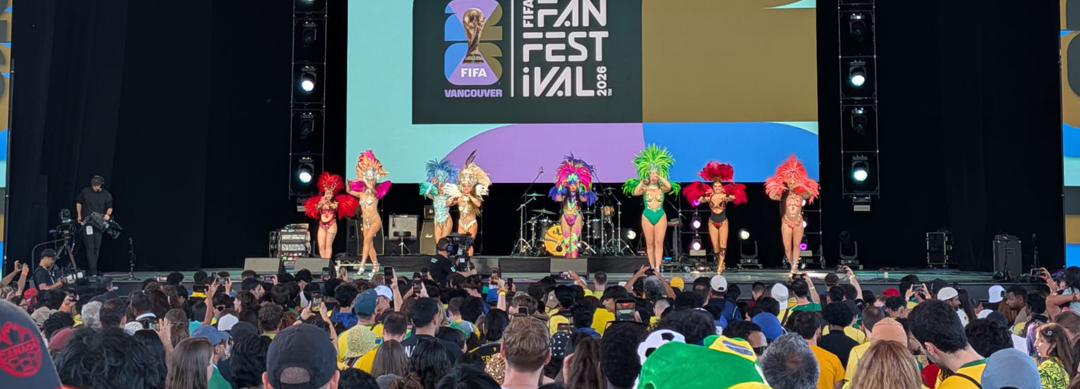
There, the World Cup unfolds at a different pace. Daily life continues uninterrupted. Offices remain open, sidewalks stay busy—but anyone wanting to watch Canada play knows exactly where to go: Granville Street, the city’s main entertainment district, transformed into a gathering place filled with giant screens, flags, and supporters from around the world.
“Canadians have a strong sporting spirit. When Canada takes the field, people support the country—even those who do not follow soccer on a daily basis,” says Eneída. For her, now experiencing the tournament for the third time from Canada, the World Cup reveals something that goes beyond sport: the profound—and fascinating—difference between two ways of celebrating.
Having lived in Vancouver for two decades, Eneída has closely observed the evolution of Canadians’ relationship with soccer. Although the sport still does not occupy the same place as ice hockey, widely considered the country’s national passion, the hosting of the 2026 FIFA World Cup has transformed Vancouver into one of the tournament’s main stages.
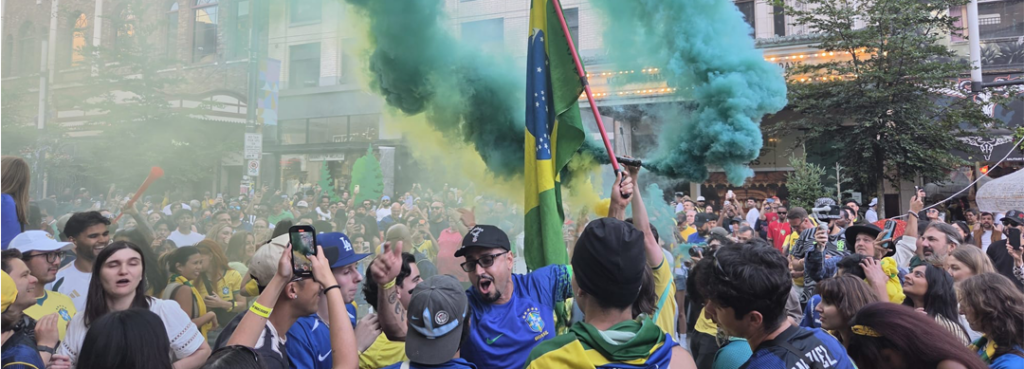
During the World Cup, Granville Street was closed to traffic and turned into a gathering point for fans from around the globe. Giant screens, flags, and outdoor viewing areas brought together residents, tourists, and immigrant communities to share the excitement of the matches.
“Soccer is not Canada’s main sport, but Canadians have a strong sporting spirit. When Canada plays, people support the national team regardless of whether they follow soccer regularly,” Eneída explains.
The most striking difference, however, lies in the way supporters experience the matches. In Brazil, a national team game often brings cities to a halt, with government offices, businesses, and even schools adjusting schedules. In Canada, daily life continues as normal. Those who want to watch a match simply organize their workday accordingly or head to a bar or public viewing area.
Soccer as cultural expression
For Eneída, what most fascinates Canadians is not necessarily what happens on the field, but what happens around it: the way Brazilians transform soccer into a collective cultural experience.
“What makes Brazil so desirable is not only its natural beauty—it is the Brazilian people,” she says. “It is our hospitality, our music, our food, and the way we celebrate together. That becomes especially visible during the World Cup.”
In Vancouver, Brazilians gather in restaurants, themed bars, and community-organized events to follow Brazil’s matches. Surrounded by flags, yellow jerseys, barbecues, and Brazilian music, these gatherings become an extension of Brazilian culture on Canadian soil.
According to Eneída, this energy often catches outsiders’ attention.
“Brazilians shout, sing, celebrate, and suffer together. It is something Canadians are not used to seeing, and they are often impressed by it.”
A World Cup that brings cultures together
The 2026 World Cup has also created opportunities to bring together communities from both countries. The concept of simultaneous coverage—following Brazilians in Canada and Canadians in Brazil—aligned with initiatives promoted by the Chamber of Commerce Brazil-Canada (CCBC), seeks to demonstrate how the same match can be experienced in completely different ways on opposite sides of the continent.
For Eneída, the tournament extends far beyond sports. It provides an opportunity to introduce Canadians to aspects of Brazilian culture that often go unnoticed beyond the country’s postcard-perfect images.
“When Brazilians come together to do something, there is nothing quite like it. The World Cup is a moment when we show who we truly are: a people who love to celebrate, be together, and turn any gathering into a party.”
That sentiment resonates across different parts of Canada. The CCBC team in the country spoke with Brazilians and Canadians in Edmonton, Montreal, and Vancouver to better understand how each experiences the World Cup. While Brazilians reorganize their schedules, put on their jerseys, prepare barbecues, and seek out their communities to cheer together, Canadians tend to follow the matches in a more relaxed way—although this edition has generated greater engagement than usual due to Canada’s role as a host nation.
In cities such as Vancouver, which hosts tournament matches, the change in atmosphere is evident: more tourists, public events, and a festive environment that brings different communities together. In Montreal, which is not hosting games, the World Cup unfolds more quietly, although local Brazilians still take every opportunity to gather in pubs and celebrate with fellow countrymen.
One comparison surfaced repeatedly among those interviewed: the Brazilian passion for soccer mirrors, in intensity, the Canadian passion for ice hockey. Different sports, the same flame.
For the Canadians interviewed by the CCBC, contact with Brazilian supporters is often a pleasant surprise.
“The passion Brazilians have is remarkable. They turn every match into a celebration,” said one interviewee in Edmonton.
For Brazilians, meanwhile, experiencing the World Cup in Canada is a way to ease homesickness while sharing a piece of their identity with those around them.
Soccer beyond the pitch
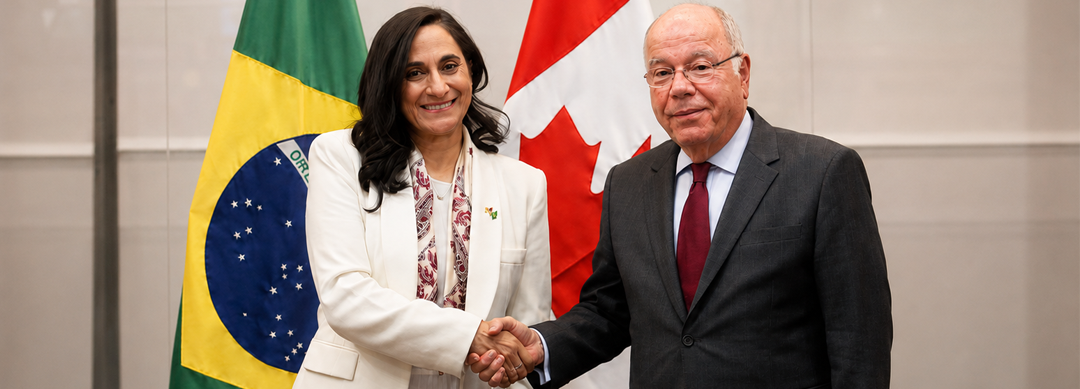
The World Cup has also become a tool for institutional engagement. In São Paulo, at the Football Museum, located in the iconic Pacaembu district, the Chamber of Commerce Brazil-Canada (CCBC), in partnership with the Embassy of Canada in Brazil and the Consulate General of Qatar, organized an event to watch the World Cup match between Canada and Qatar—a game that ended in a commanding 6–0 Canadian victory.
The initiative brought together government officials, business leaders, members, and diplomatic representatives in an environment designed to strengthen ties between the two countries—which are rivals only within the World Cup group stage—while promoting cultural exchange, dialogue, and opportunities for cooperation.
It is the same spirit that drives Brazilians in Vancouver, whether at institutional events or spontaneous community gatherings. The World Cup reveals its most enduring power: the ability to bring people closer together and deepen understanding between nations.