

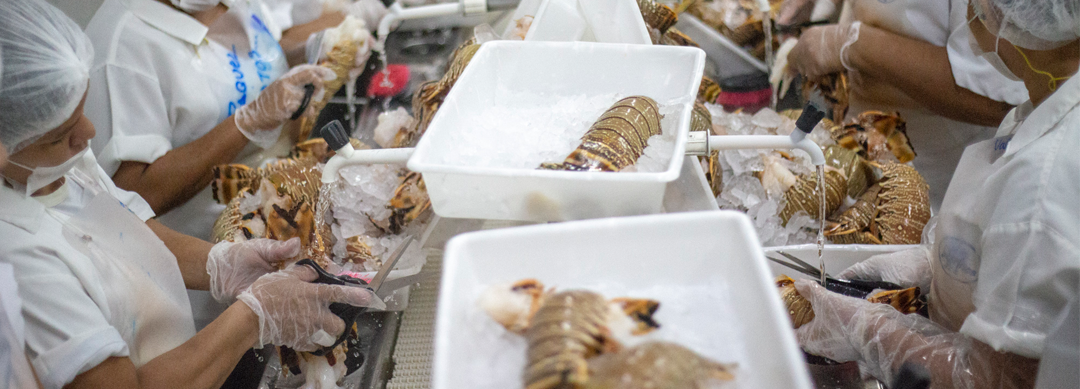
Initiative led by the Chamber of Commerce Brazil-Canada (CCBC) places the northeastern Brazilian state at the center of a bilateral seafood trade route; discussions involve business leaders, researchers, and government authorities
By Pedro Augusto
The Atlantic Ocean has become more than just a maritime route—it is now emerging as a strategic bridge between northeastern Brazil and Canada. An initiative led by the Chamber of Commerce Brazil-Canada (CCBC) is bringing together the state of Ceará and the Canadian province of Nova Scotia around an ambitious Blue Economy agenda, a concept encompassing ocean-related activities, marine innovation, fisheries, aquaculture, logistics, and sustainability.
The initiative promoted by the CCBC aims to connect Brazilian and Canadian fisheries businesses, government authorities from both countries, and leading institutions in Nova Scotia, including Dalhousie University (Halifax, Canada’s leading university in marine research); the Bedford Institute of Oceanography (Dartmouth, Canada’s largest federal ocean research center, focused on fisheries management and marine biodiversity); and COVE (Centre for Ocean Ventures & Entrepreneurship), an ocean technology hub located at the Port of Halifax, home to more than 60 companies and startups. The goal is to establish a bilateral Blue Economy corridor that combines production capacity, technology, scientific exchange, and investment to generate high-value business opportunities in both countries.
The initiative gains momentum at a time when bilateral seafood trade between Brazil and Canada is experiencing consistent growth, with figures highlighting the relationship’s expansion potential. Between January and May 2026, Brazilian seafood exports to the Canadian market totaled US$1.82 million. Ceará accounted for US$217,400 of that amount, representing 11.9% of all Brazilian seafood exports to Canada during the period.
These figures reinforce the state’s importance in the trade relationship between the two countries. Between 2023 and 2025, Ceará’s seafood exports to Canada surged from US$525,000 to US$2.05 million, a 291% increase in just two years. Over the same period, Brazil’s overall seafood exports to Canada grew from approximately US$2.7 million to US$7.3 million, an increase of 167%.
This prominence helps explain why Ceará has entered the international Blue Economy spotlight. In 2024, the state generated US$93.8 million in fisheries exports and accounted for approximately 25% of all seafood exported by Brazil. Ceará also leads the country in marine aquaculture production and was responsible for more than half of the Northeast region’s output.
“Ceará has historically been closely associated with social and economic development linked to ocean-based activities. When we identified Canada as a strategic market, we realized there was a very clear complementarity between the two ecosystems,” says Igor Gonçalves, creator of the initiative and coordinator of the Ceará Chapter, one of the Chamber’s regional hubs.
According to him, the decision to prioritize the Blue Economy as the cornerstone of the partnership was driven by its potential to generate more immediate commercial results than sectors dependent on long-term infrastructure investments.
“We believe the Blue Economy can be the most effective tool for immediate engagement because it is based on commercial relationships with significant complementary potential,” Gonçalves says.
An Atlantic corridor for seafood, innovation, and ocean technology
The partnership between Brazil and Canada extends beyond fish and shellfish exports. Nova Scotia is recognized as one of the world’s leading hubs for ocean technology and marine innovation, creating opportunities for scientific exchange and the joint development of solutions for the fisheries value chain. The CCBC’s strategy has been to build this bridge through industry associations and institutional partners capable of expanding the initiative’s reach and connecting stakeholders within a single ecosystem.
“Our initial focus has been working with industry associations and institutions because they are able to broaden the reach of this agenda and connect businesses, universities, and governments within the same ecosystem,” says Gonçalves.
Among the organizations already engaged in discussions are government-related agencies in Nova Scotia, including Invest Nova Scotia, Invest Halifax, and Nova Scotia Intergovernmental Affairs.
Commercial complementarity creates a strategic opportunity
The trade relationship presents a rare scenario of complementarity between the two markets. On the Brazilian side, Canada seeks tropical species and premium, high-value products such as frozen red snapper, tuna, lobster, and tilapia fillets. Ceará’s leading export to the Canadian market is currently frozen red snapper (Lutjanus purpureus).
Brazil, in turn, has strong demand for cold-water fish and premium seafood products produced in Canada. Today, approximately 90% of Brazilian imports of Canadian seafood consist of frozen scallops, a segment in which Nova Scotia ranks among the world’s leading producers.
There is also significant potential to expand trade flows with products such as cod, cold-water lobster, and salmon. However, the partnership between Ceará and Nova Scotia goes beyond traditional trade. The agenda under development also includes opportunities to add value throughout the production chain through seafood processing, technology exchange, and bilateral investment.
According to Hilton Nascimento, President of the Chamber of Commerce Brazil-Canada (CCBC), the complementarity between the two markets creates favorable conditions for joint projects capable of increasing business scale and sector competitiveness.
“We are not talking solely about exporting seafood for final consumption. There is room to add value, process products, and create new business opportunities for companies in both countries.”
The possibility of establishing seafood processing facilities in Canada, including with the participation of Brazilian companies, is viewed as one of the most promising opportunities. In addition to serving the local market, these facilities could utilize raw materials from both countries and expand access to international markets.
“We are connecting two regions with a strong maritime vocation. Ceará brings production capacity, while Nova Scotia contributes technology, research, and innovation. This combination can generate highly significant results for the Blue Economy,” Nascimento says.
