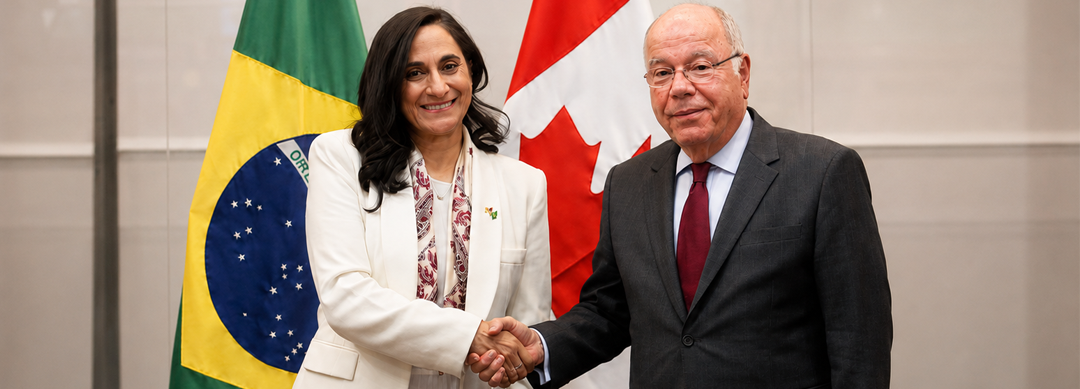

The Brazil-Canada Economic Forum brought together authorities and executives in São Paulo to discuss bilateral cooperation in strategic resources
By Pedro Augusto
Ongoing shifts in the global economy—driven by the energy transition, the reorganization of production chains, and growing competition for natural resources—have already begun to reshape the map of international trade. In this new context, Brazil and Canada are emerging as natural partners in strategic sectors such as energy and mining. To discuss this topic and explore ways to open new avenues for consistent bilateral trade, diplomatic authorities, business leaders, and experts from both countries gathered at the 4th edition of the Brazil-Canada Economic Forum, held this April in São Paulo.
The goal is to encourage Brazilian and Canadian companies to seize opportunities arising from the so-called “new economy” to strengthen commercial ties. On one hand, there is a global movement—led by countries committed to sustainability—toward the gradual replacement of fossil energy sources, such as oil, coal, and derivatives, with renewable alternatives (such as solar, wind, and hydroelectric power). This process, accelerated by climate targets and regulatory pressures, has required massive investments in energy infrastructure and new technologies.
On the other hand, the electrification of the economy—particularly the large-scale adoption of more sustainable vehicles, as well as energy storage and industrial digitalization—has significantly increased demand for strategic minerals such as lithium, nickel, copper, and rare earth elements, which are essential inputs for the production of batteries, wind turbines, solar panels, and power grids.
At the same time, as the world seeks solutions for an energy transition in favor of sustainability, geopolitical tensions and recent logistical disruptions have exposed the vulnerability of traditional global supply chains tied to oil. This context is prompting countries and companies to seek suppliers in alternative markets and diversify their sources of inputs. It is within this framework that bilateral partnerships gain relevance, as highlighted by the president of the Chamber of Commerce Brazil-Canada (CCBC), Hilton Nascimento.
“We are living through a period of profound transformations in the global economy; the reorganization of production chains, geopolitical tensions, the energy transition, and growing competition for strategic resources are leading countries to revisit their partnerships and seek greater economic diversification,” he stated.
Critical minerals at the center of the agenda
The rising demand for critical minerals was also a central topic at the forum and is helping to drive structural changes in the global economy. Resources such as lithium, cobalt, graphite, and rare earth elements are now key inputs for the energy transition and the high-tech industry.
Lithium is essential for electric vehicle batteries and energy storage systems. Rare earth elements, in turn, are used in permanent magnets found in wind turbines, electric motors, and electronic equipment. Copper is indispensable for power grids and transmission infrastructure.
In this scenario, Brazil and Canada appear as complementary partners. Canada stands out as one of the world’s leading mining hubs, with dozens of active critical mineral mines, installed processing capacity, and a sector that contributed around US$40 billion to Canadian GDP in 2023, according to the Canadian government. The country combines a strong technological base with well-established companies across the production chain.
Brazil, on the other hand, combines abundant mineral reserves, vast territory, and a predominantly clean energy matrix—about 78.5% of its electricity generation comes from renewable sources, according to the Ministry of Mines and Energy. This advantage is strategic for attracting energy-intensive industries such as refining and mineral processing.
This convergence of attributes helps explain the current moment in bilateral relations. “For Canada, Brazil is not just a bilateral partner; it is a strategic partner on a global scale,” said Canada’s ambassador to Brazil, Emmanuel Kamarianakis, highlighting the potential for cooperation in energy- and mining-related supply chains.
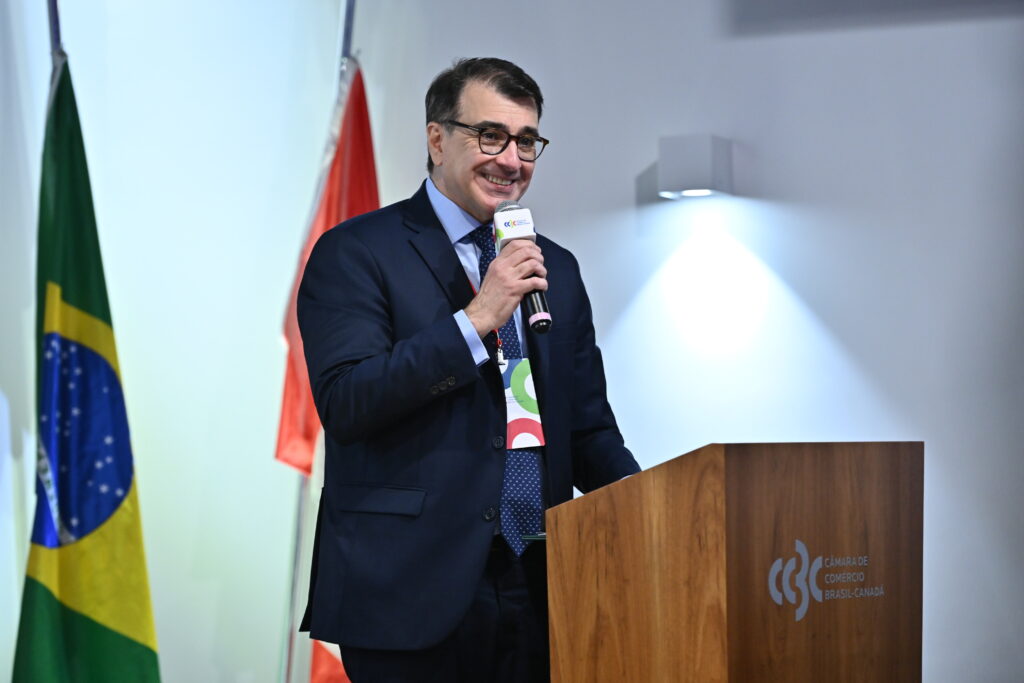
Reproduction/CCBC
Along the same lines, Brazil’s ambassador to Canada, Carlos França, noted that the current context has increased the importance of these sectors in the global economy. “Mining, energy, and infrastructure are no longer just economic sectors; they have become central pillars of global competitiveness.”
The challenge of adding value
Despite these advantages, one of the main issues raised at the forum was the risk that Brazil may remain focused on exporting raw materials without advancing to higher value-added stages.
Currently, a large share of the minerals extracted in the country is exported with low levels of processing. In 2025, Brazil shipped more than 430 million tons of mineral products abroad, with a strong predominance of commodities such as iron ore, which accounts for over 60% of the sector’s exports, according to consulting firm KPMG. The Brazilian government itself acknowledges the need to expand local processing to capture more value in production chains, which are currently concentrated in stages carried out outside the country.
The debate indicated that the bottleneck is not merely geological but structural, involving the business environment, industrial policy, and coordination capacity. “Today Brazil does not have sufficient tax incentives; we need mechanisms to be competitive and attract these refining chains,” said Marisa Cesar, chair of the board of the Critical Minerals Association, during the forum.
According to experts, transforming mineral potential into industrial capacity requires progress in stages such as refining, chemical processing, and technological development—segments where greater value generation is concentrated.
At the same time, the country has conditions considered favorable in the international scenario. “We have cheap energy at a time when energy costs are rising worldwide, and we have the main critical minerals,” said Oswaldo DalaTorre, partner at TozziniFreire Advogados, highlighting Brazil’s comparative advantages.
The window of opportunity is open. The challenge, according to experts, is to ensure that Brazil moves beyond its role as a supplier of natural resources and positions itself as a relevant industrial link in global value chains.