
Growing demand for critical minerals increases pressure on the sector and reinforces the need to engage communities, align regulations, and strengthen Brazil–Canada cooperation
By Pedro Augusto
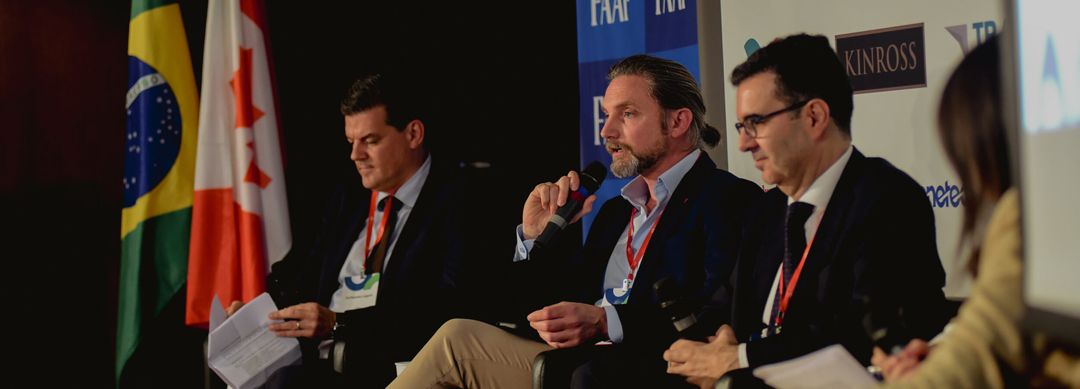
The energy transition will advance only if governments, companies, and communities act in cooperation. In this context, sectors such as mining are at the center of attention. This was the tone set by executives from the mining, renewable energy, and sustainable finance sectors during the Energy Transition and Sustainable Finance panel at the Brazil-Canada Summit, held in November in São Paulo. They discussed how both countries can structure value chains capable of meeting the rising demand for essential minerals.
According to experts, global demand for copper, nickel, and cobalt has grown significantly, driven by the need for batteries, wind farms, data centers, and digital technologies. This scenario is seen as an inevitable source of pressure on the extractive sector—one that requires coordinated action across different segments of society.
“Continuous dialogue with communities is essential,” said Tatiana Ricota, Sustainability Director at Elera Renováveis. She cited the company’s work in the Janaúba Complex in Minas Gerais as an example. “We achieved over 90% social approval after continuous consultation with the local community.”
Active listening was also highlighted as essential by Mônica César, General Manager of Corporate Affairs at Vale Base Metals, for companies seeking to foster meaningful sustainability with the populations living around their projects. “The energy transition will only be legitimate if it is inclusive, with active listening and joint planning with communities.” She emphasized that responsible operations must ensure that socioeconomic benefits remain after the mining cycle in these regions ends.
Regulation and Sustainable Finance
The mining sector faces regulatory challenges that require adaptation. Luciano Santos, Legal Director at Lundin Mining, emphasized that legal requirements need flexibility to make projects viable. One path forward, he said, is to promote collaboration among regulators, companies, and communities before projects are developed and executed.
In addition, projects require sustainable financing. To boost the mining chain—which is capital intensive—one approach is to analyze international experiences and adapt them to local realities. “More modern climate taxonomies incorporate diversity, integrity, and socio-environmental impact as central criteria,” said Florian Roulle, Vice President of Sustainable Finance at Finance Montréal.
The expert noted that Brazil and Canada have made progress in developing such systems. “They don’t need to be identical—only able to work together. This approach reduces risk, increases confidence, and unlocks capital for entire value chains, from agriculture to mining.” Roulle also observed that, today, investment has shifted from isolated projects to sector-wide transformation strategies, especially in segments dependent on critical minerals.
Strategic Partnership
Brazil–Canada cooperation is a cross-cutting element for a sustainable energy transition. Brazil offers geological advantages and abundant renewable electricity. In 2024, the country’s energy matrix was composed of 88% clean sources. Canada, in turn, offers low-impact mining technologies, ESG certifications, digital traceability systems, and expertise in sustainable finance.
Both nations offer concrete opportunities for exchange, including technology transfer for processing critical minerals, harmonization of environmental standards, green taxonomy models, and academic partnerships for applied research. For progress to occur, experts stressed that communities cannot bear the costs of the transition alone and that mining companies must distribute value, ensure local benefits, and build long-term relationships that consolidate the so-called “social license to operate.”
The Energy Transition as an Economic Lever
The energy transition must be understood as an economic catalyst, not merely an environmental agenda. This was the message delivered by Elbia Gannoum, President of the Brazilian Association of Wind Energy and New Technologies (ABEEólica), echoing the viewpoints of the experts on the Energy Transition and Sustainable Finance panel.
Addressing geopolitical challenges and the need for financing in developing countries, Elbia stated that the energy transition must be understood as a business. “When governments and companies see this movement as an investment opportunity, implementation happens because it is driven by economic logic, competitiveness, and technological innovation.”
She also emphasized that Brazil has unique conditions to become the world’s leading hotspot for clean energy investment, due to its renewable energy matrix and its capacity to produce low-carbon biofuels.