Procedural efficiency, international trade, tax reform and corporate crises were among the topics discussed over two days
By Pedro Augusto and Marcelo Picolo
Reaching technically sound decisions without allowing proceedings to drag on for years is one of the main challenges facing arbitration amid the growing complexity of corporate disputes. The issue was at the center of the 13th CAM-CCBC Arbitration Congress, held on October 19 and 20 at the JW Marriott Hotel São Paulo, in Chácara Santo Antônio, in the southern part of the city.
The event brought together experts to discuss efficiency, changes in international trade, tax reform, corporate crises and other issues. In the year the Brazilian Arbitration Act (Law No. 9,307/1996) marks its 30th anniversary, the discussions also reviewed the institution’s progress in Brazil and what is needed to preserve its effectiveness.
In the opening keynote address, international arbitrator Carmen Núñez-Lagos warned of the economic impact of delays in dispute resolution. “A technically perfect decision, but one issued five years later, may lose part of its economic value,” she said. According to the expert, the growing volume of documents and expert evidence prolongs proceedings and increases costs. To address the problem, she advocated a more active role for arbitrators in managing deadlines, organizing the presentation of evidence and curbing delaying tactics.
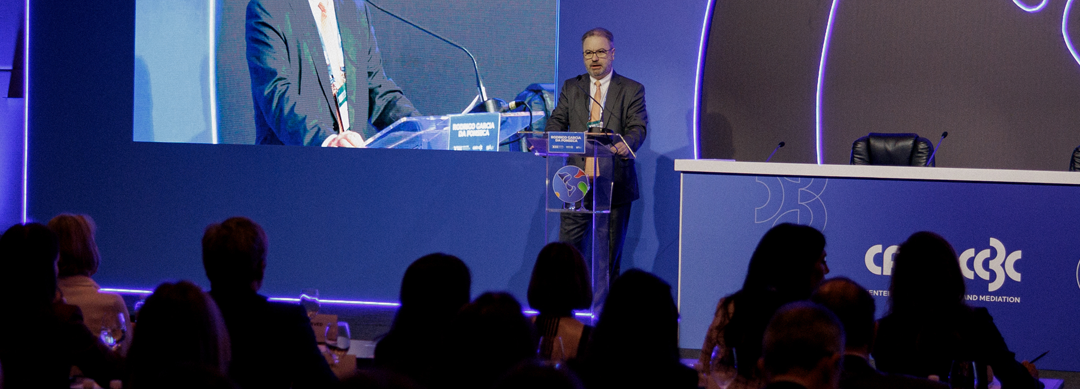
At the opening ceremony, CAM-CCBC President Rodrigo Garcia da Fonseca attributed the international recognition achieved by Brazilian arbitration over the past three decades to the arbitration community itself. “This respect was built largely by people who are here in this room,” he said. Among the institutional advances he highlighted were improvements in governance, software for the digital management of proceedings and a collection of publicly available arbitral awards, which brings together 46 decisions.
In 2026, to date, CAM-CCBC has registered 100 new arbitration cases, 12 mediations, three dispute boards, eight emergency arbitrator proceedings and four requests for the taking of evidence in advance. The institution administers approximately 400 ongoing cases.
The program also addressed mediation as a tool for debt restructuring and judicial reorganization, arbitration in infrastructure contracts in light of tax reform, and governance issues and abuse of power in funds. Discussions also examined the impact of recent decisions by international courts on arbitration, providing an overview of the legal and institutional issues shaping dispute resolution in Brazil and worldwide.
At the closing session, Carlos Alberto Carmona, Selma Ferreira Lemes and Pedro Batista Martins, the authors of the preliminary draft that led to the Brazilian Arbitration Act, analyzed the factors behind the mechanism’s consolidation in Brazil and discussed the direction arbitration should take in the years ahead.
Poorly drafted contracts leave exporters bearing the cost of US tariffs
Without clear rules governing tariff changes, export contracts can leave Brazilian companies bearing the full cost of US surcharges, which can reach 37.5% on Brazilian products. The risk was the subject of the congress’s first panel.
Ank Santens, of the law firm White & Case, highlighted the application of provisions commonly included in contracts to unexpected situations. In such cases, she said, it is necessary to consider the rules governing international trade, identify which party has been left exposed and determine how the law should be interpreted.
Force majeure clauses, a traditional safeguard against unforeseen events, do not always protect companies against tariffs and sanctions. How losses are allocated depends on the wording of each clause, the law governing the contract and the terms of the transaction. Dietmar W. Prager, a partner at Debevoise & Plimpton and co-chair of the International Bar Association’s (IBA) Arbitration Committee, noted that long-term contracts in agribusiness and commodity trading are among the most exposed, as they can remain in force for decades and feature prices tied to benchmark indices.
For John A. Trenor, head of International Arbitration at WilmerHale, contracts must be reviewed before a dispute arises, clause by clause, with careful attention to differences between national legal systems. When a dispute does occur, he recommends starting with the desired outcome and determining whether the company wants to maintain the contract, renegotiate its terms, recover amounts owed or terminate the commercial relationship. Emergency arbitration, he noted, can be decisive when urgent action is needed to preserve rights.
The panel was moderated by Elias Marques de Medeiros Neto, of TozziniFreire.
Sanctions extend into arbitration
The effects of economic sanctions extend beyond the parties directly involved. Fernando Merino, of Steptoe, warned of secondary sanctions, which target companies for maintaining commercial relationships with sanctioned individuals or entities. “Economic sanctions have become a significant tool of US foreign policy,” he said. According to Merino, mergers, acquisitions and foreign investments in Brazil require a prior assessment of this risk, with particular attention to investors’ nationalities and companies’ ownership and control structures.
Even the choice of arbitration must be taken into account. According to Prager, arbitrators and arbitral institutions may need licenses to handle cases connected to sanctions, and the existence of an arbitration clause does not eliminate this obstacle. The seat of arbitration, the institution selected and the professionals involved may all be affected.
The international dimension of disputes is reflected in CAM-CCBC’s figures. In 2025, 39.3% of the 122 arbitration cases administered by the institution, the country’s largest arbitration chamber, involved at least one foreign party. The United States accounted for 38.1% of international cases.