By Tiago de Mattos, coordinator of CCBC’s Belo Horizonte Chapter
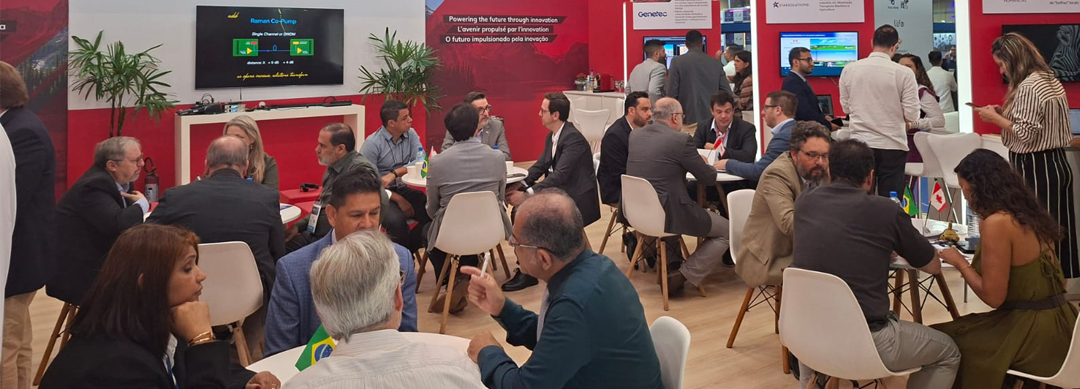
Between August 24 and 27, 2026, Belo Horizonte once again became the center of Latin American mining. The Brazilian Mining Expo & Congress (Exposibram 2026), organized by the Brazilian Mining Association (IBRAM) at Expominas, also marked the association’s 50th anniversary and reached unprecedented scale: more than 750 booths, over 17,000 square meters of exhibition space, and record attendance, according to the official figures released at the close of the event. The event confirmed that mining has taken center stage in discussions on the energy transition, supply chains, and reindustrialization.
For those following relations between Brazil and Canada, this year’s edition held special significance. In 2026, the two countries celebrate 85 years of diplomatic relations, with mining standing out as one of the main pillars of this partnership.
The main themes at Exposibram 2026
The Brazilian Mining Congress program focused on critical and strategic minerals, the geopolitics of mineral resources, decarbonization, innovation, artificial intelligence and digital transformation, licensing, and investment attraction. During the opening ceremony, IBRAM highlighted progress on the legal framework for critical minerals, the publication of the National Mining Plan 2050, and proposals to expand financing for the sector, including mechanisms to enable stock market listings under the junior mining model, as seen in Canada and Australia.
The discussions underscored that mining’s legitimacy depends on operational safety, genuine engagement with territories and communities, and a net positive socio-environmental contribution. A panel on countries’ strategic approaches to critical minerals brought together representatives from Canada, Australia, the United States, France, and the United Kingdom, including Helen Belgrave, then Acting Consul General of Canada in Rio de Janeiro, highlighting international interest in Brazil’s potential.
Canada’s strong presence
Canada was one of the event’s leading participants. The Canadian Trade Commissioner Service organized a program showcasing Canadian solutions in clean technology, artificial intelligence, automation, and innovation, featuring business matchmaking sessions, the Canada Pavilion, and a visit to the SENAI-CIT center dedicated to magnets and rare earth elements. At the start of the week, on August 24, FIEMG hosted the Canada-Brazil Mining Business Forum, organized in partnership with the Government of Canada and the province of Quebec, bringing a delegation of 20 Quebec-based companies to Belo Horizonte.
On that occasion, Joanne Lemay, Consul General of Canada in São Paulo, noted that Canada is the largest foreign investor in Brazil’s mining sector: more than 40 companies listed on the TSX and TSX Venture Exchange operate or invest in Brazil, with more than C$16 billion in mining assets. Canadian companies were also prominently represented among the exhibition’s sponsors, including Ero Copper, Lundin Mining, and Kinross. Ero’s booth received the award for best exhibit in its category.
CCBC’s Happy Hour: diplomacy and business side by side
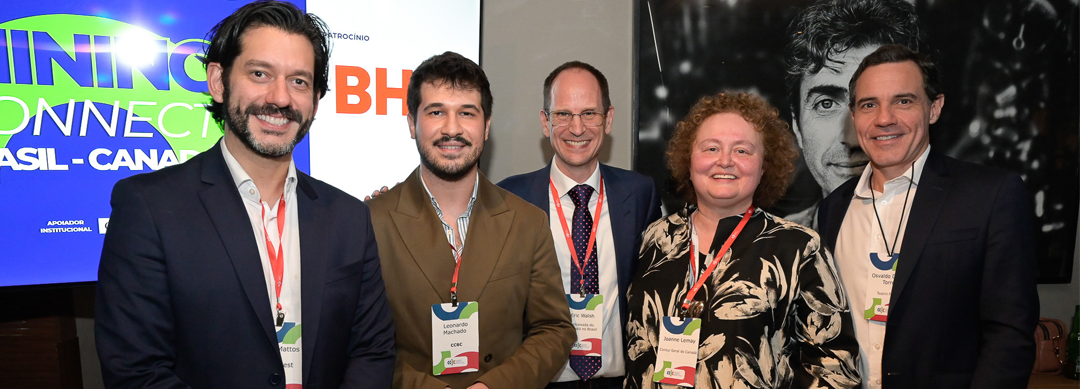
Amid the week’s packed schedule, the Brazil-Canada Chamber of Commerce (CCBC) hosted a Happy Hour bringing together members, mining industry executives, investors, and public officials. The gathering was attended by Canada’s Ambassador to Brazil, Eric Walsh, who had recently arrived in the country, as well as representatives of the Canadian Consulate and CCBC’s Belo Horizonte Chapter. In an informal setting, the event brought people together and deepened conversations that had begun at the exhibition booths.
The message aligned with the priorities outlined by the Ambassador himself. In an interview with News CCBC, Walsh stated that, if he had to highlight one sector, “mining and critical minerals would probably be at the top of the list,” pointing to the development of more resilient supply chains and cooperation with Brazil in implementing its new National Plan for Critical and Strategic Minerals as key areas for collaboration.
Opportunities for cooperation: innovation, sustainability, critical minerals, and investment
Brazil’s regulatory environment underwent significant changes shortly after the event. On September 16, 2026, Law No. 15,506/2026 was enacted, establishing the National Policy on Critical and Strategic Minerals (PNMCE) and creating the National Council for the Industrialization of Critical and Strategic Minerals (CIMCE). The law prioritizes domestic value addition, authorizes the creation of a Guarantee Fund for Mining Activities, with federal government participation of up to R$2 billion, and provides for tax credits of up to R$1 billion per year from 2030 to 2034 for mineral processing, transformation, and urban mining. The CIMCE will also be responsible for approving certain transactions, including changes of control and significant acquisitions by foreign investors, an important consideration for Canadian investors.
In this context, the complementarity between the two countries is clear. Canada offers established expertise in mining finance through capital markets, technology, governance, and engagement with Indigenous peoples. According to Natural Resources Canada, the country has approximately 500 impact and benefit agreements signed between companies and Indigenous communities. In September, Brazil’s National Mining Agency, Natural Resources Canada (NRCan), and the Canadian Embassy met in Brasília to discuss cooperation on critical minerals, innovation, technical training, and regulatory best practices, while a Memorandum of Understanding between Brazil’s Ministry of Mines and Energy and the Canadian government remains pending formalization.
Next steps: on the road to PDAC 2027
The coming months will be crucial for establishing the CIMCE, defining the list of critical and strategic minerals, and regulating the incentives. For companies and investors in both countries, this will be an opportunity to turn the interest demonstrated in Belo Horizonte into concrete projects.
The next major gathering on this agenda will be PDAC 2027, the world’s leading convention for mineral exploration, taking place from March 7 to 10, 2027, in Toronto. The 2026 edition of PDAC brought together more than 32,000 participants from 141 countries, with Brazil among the largest foreign delegations. A coordinated Brazilian presence in Toronto will provide a valuable opportunity to present the new regulatory framework and national projects to Canada’s capital markets.
From Exposibram to PDAC, the message is clear: Brazil and Canada have the resources, expertise, and institutions to work together toward a more innovative, sustainable, and competitive mining industry. It is now up to the business communities and forums such as CCBC to keep this bridge active.
*This article does not necessarily reflect CCBC’s views and is the sole responsibility of its author.