
By the Trade Commissioner Service – Brazil Team, Government of Canada
When Futurecom 2026 opens its doors in São Paulo this October, Canadian companies will once again join Brazilian industry leaders to showcase technologies that are transforming the way businesses, governments and communities connect around the globe. As the largest international representation at Latin America’s leading connectivity and digital transformation event, Canada’s participation is much more than just demonstrating the latest technological advances: it is yet another chapter of the Canada-Brazil ICT partnership that has been unfolding for decades.
If we go back to the 1990s, when Brazil was opening its telecommunications market to private investment and undertaking one of the most significant transformations of its communications infrastructure, Canadian companies were there. Nortel Networks became one of the major technology and equipment providers to the market, while Bell Canada brought expertise and investments into Brazilian telecommunications infrastructure as well. As mobile communications took off, BlackBerry became another familiar Canadian name, bringing secure mobile technology to businesses and consumers in Brazil – who can forget that iconic keyboard!
That early engagement helped establish a relationship that has grown alongside the sector itself. The conversation has moved from traditional telecom networks and mobile communications to cybersecurity, cloud computing, satellite connectivity, artificial intelligence and digital transformation. And while the names and technologies may have changed, Canadian companies have remained part of Brazil’s evolving digital landscape with companies such as OpenText and Telesat part of a new generation of Canadian innovation and expertise pursuing opportunities in the Brazilian market.

That transformation extends well beyond telecommunications: Canadian technologies are increasingly crossing traditional industry boundaries; finding applications in sectors that are central to Brazil’s economy; and driving international commercial cooperation and diversification. In São Paulo state this year, Canadian solutions will enable private 5G cellular networks to bring dedicated connectivity to rural areas. Other technologies offer a highly durable, tamper-resistant data storage and archival system designed to preserve information for more than a century. From mining and banking, to manufacturing and agriculture, Canadian ICT companies are applying technologies to solve very different business challenges across some of Brazil’s most dynamic industries.
Canada’s ICT industry comprises more than 48,000 companies and employs approximately 802,000 professionals back home and abroad. Representing 5.8% of national GDP, the sector accounts for more than 45% of all private-sector research and development investment in Canada. Annual business R&D spending reaches approximately CAD $12 billion—investment that is driving advances in fields increasingly relevant to Canadian and Brazilian organizations alike.
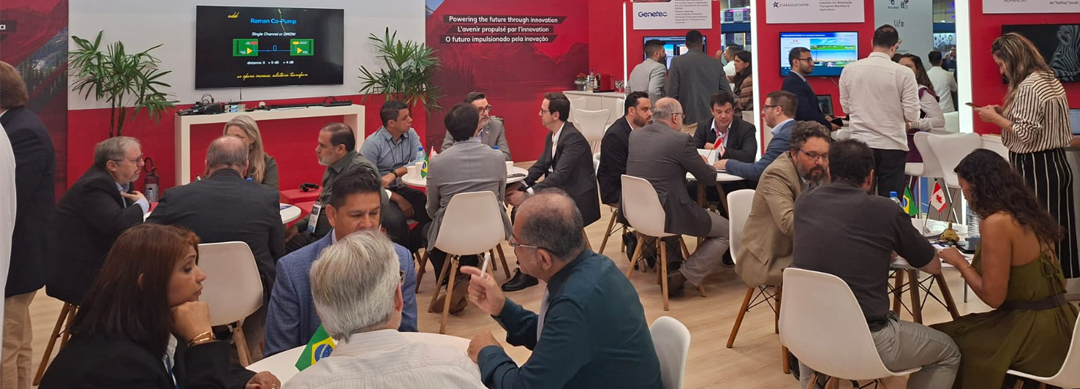
Futurecom offers a fitting snapshot of this longstanding engagement. Now in its third decade, the event has repeatedly brought Canadian companies, governments and technology organizations together with Brazilian partners, creating a platform not only to showcase technology but to build commercial relationships, exchange expertise and explore what comes next. No fewer than 22 Canadian companies will be in attendance this year, making Canada the most present international partner at the show.
In a year when Canada and Brazil celebrate 85 years of official diplomatic relations, telecommunications and ICT offer a tangible example of what long-term partnerships can grow to become. Canada was present during a pivotal period in the development of Brazil’s modern telecommunications sector; it remained engaged as the market and technologies evolved; and it is here today, working with Brazilian partners to build the next generation of connectivity and digital innovation. We look forward to seeing you there!
*This text does not necessarily reflect the views of the CCBC and is the sole responsibility of the author.