By Artur Bertone, New Business manager at HIDROBR
In 1695, the world was significantly different from today. That year, in particular, bandeirante Manuel Borba Gato, during his expeditions through Terra Brasilis, discovered gold in the Rio das Velhas, marking the beginning of Brazil’s gold rush in the region of Minas Gerais.
Shortly afterward, in 1698, Vila Rica was founded, today known as Ouro Preto. In 1720, it became the capital of the state of Minas Gerais, a position it held until the founding of Belo Horizonte in 1897.
Coincidentally or not, just a few years earlier, in 1889, Latin America’s first hydroelectric power plant, Marmelos Zero, began operating on the Paraibuna River in Juiz de Fora, Minas Gerais. It was built to supply a textile factory. An interesting event at the time was that industrialist Bernardo Mascarenhas, knowing that the plant would produce more energy than his factory required, proposed that the municipality be allowed to use the surplus to power public lighting. The move caused unrest in the community, dividing residents between those who supported the initiative and those who were firmly opposed, believing that the light coming through those cables could only have come from hell. Perhaps this was the first polarization of Juiz de Fora society, or even of Minas Gerais, and it was resolved through a technical explanation by an engineer who, as the saying goes, proved that it was not magic, but technology.
During the same period, the first public concession in Brazil’s newly established electricity sector was granted to Thomas Edison, inventor of the incandescent light bulb, to provide public lighting for the city of Rio de Janeiro.
The years passed, and both the electricity and mining sectors developed, each contributing its share to the growth of the national economy, which would eventually become the world’s fifth-largest economy at its peak.
As for the electricity sector, Brazil now has one of the largest and most robust interconnected power systems in the world, operating more than 176,000 km of transmission lines responsible for transmitting approximately 253,061 MW of electricity generated from different sources. Around 90% of the grid comes from renewable sources, including hydropower (43%), wind power (14%), solar power (8%) and biomass (6%), with approximately 20% also coming from distributed generation based on renewable sources.
In the mining sector, revenues reached an impressive R$298.8 billion in 2025, an increase of 10.3% from the previous year. Iron ore remains dominant, accounting for 53% of revenues. However, gold and copper stand out, with revenue growth of 65% and 50%, respectively, demonstrating the strength of diversification. This is also reflected in the sector’s regional distribution, with Minas Gerais and Pará remaining the main mining states, accounting for 40% and 35%, respectively. At the same time, Bahia saw a surprising 33% increase in its share, while Mato Grosso and Goiás grew by 28%, representing Brazil’s new mining frontiers.
These two sectors, which are extremely important to Brazil, have close connections and longstanding ties. During the development of Brazil’s electricity sector, many power plants were built to supply mining operations, which, due to the nature of their activities, required a constant and stable supply of energy. This pioneering effort was fundamental to the development of Brazil’s electricity sector and even helped create the conditions for mining companies today to increasingly sell their energy assets or business units, reflecting their confidence in the country’s robust power system.
However, amid the complexities of modern times, the two sectors now face completely different challenges that may have a common solution.
After decades of extraction and the opening of new mining fronts, the mining industry now has to deal with the challenges associated with mine closure. This is far from a straightforward process, as an operation of this scale develops intricate relationships with the territory, communities and economies of the regions where extraction takes place over the years.
The challenges of mine closure are not exclusively technical or environmental, nor are they limited to the decommissioning of structures and facilities. Today, more than ever, it is necessary to look at the region that hosted a mining operation for decades and understand the relationships that were created through direct impacts such as employment, tax revenues, service contracts and so on. But it is also necessary to consider the indirect dimension: ways of life, the local environment and how the community adapted and transformed over time, heavily influenced by the operation.
Given this context, what is the best way to carry out a mine closure process? How can we address not only the productive dynamics and technical aspects of decommissioning, but also socioeconomic and cultural issues? This is one of the major challenges facing the mining industry today.
On the other hand, Brazil’s electricity sector is perhaps experiencing its most uncertain period. The significant expansion of solar and wind power in the country’s energy mix, combined with the rapid growth of distributed generation, is forcing the system to deal with uncertainties and challenges never seen before. Distributed generation, meaning the ability of individual consumers to generate their own electricity, whether on the roof of their home or at a dedicated facility, is at the same time an extraordinary tool for decentralizing the need for investment in power generation in Brazil and a major headache for the ONS, which is responsible for operating the national electricity system and, therefore, for ensuring energy security. In other words, when you plug an appliance into an outlet, there must be electricity available.
This challenge arises because, unlike hydropower and sources based on fuels such as coal, biomass and others, wind and solar generation cannot be controlled. Their main inputs, wind and sunlight, are not on the generator’s control panel. For those responsible for coordinating electricity distribution across the country, dealing with an intermittent source is more than a headache. It is a full-blown migraine, complete with clusters and auras.
The consequences of these two challenges can already be seen in the numbers. In the electricity sector, 20% of potential solar and wind generation was curtailed in 2025, meaning that an average of 4,021 MW was lost, resulting in estimated losses of R$6.5 billion. This occurs because surplus electricity on the grid cannot currently be stored at the necessary scale, requiring generation to be curtailed to maintain system stability. In the power system, the challenge is not simply to increase electricity generation, but to ensure that electricity is generated at the right time.
For the mining sector, according to data from Instituto Escolhas, Brazil has approximately 3,943 mining processes showing indications of abandonment, meaning mines that have been abandoned without undergoing the proper closure process. In addition to abandoned operations, several mines are currently undergoing closure and facing numerous difficulties in moving forward because of the complexity discussed above.
But what if these two challenges could share a single solution?
First and foremost, it is important to keep our feet on the ground and remember that there are no simple answers to complex problems. As Carl Sagan would say, extraordinary claims require extraordinary evidence. We are not making an extraordinary claim here, but rather proposing an alternative that deserves to be explored and studied.
One of the alternatives for addressing the volatility of solar and wind power lies precisely in the construction of pumped-storage hydropower plants. Put simply, these facilities consist of two reservoirs located at different elevations. When there is excess energy in the system, that surplus is used to pump water from the lower reservoir to the upper one. In this way, the upper reservoir is effectively recharged, keeping it ready for periods when there is no surplus energy available on the grid.
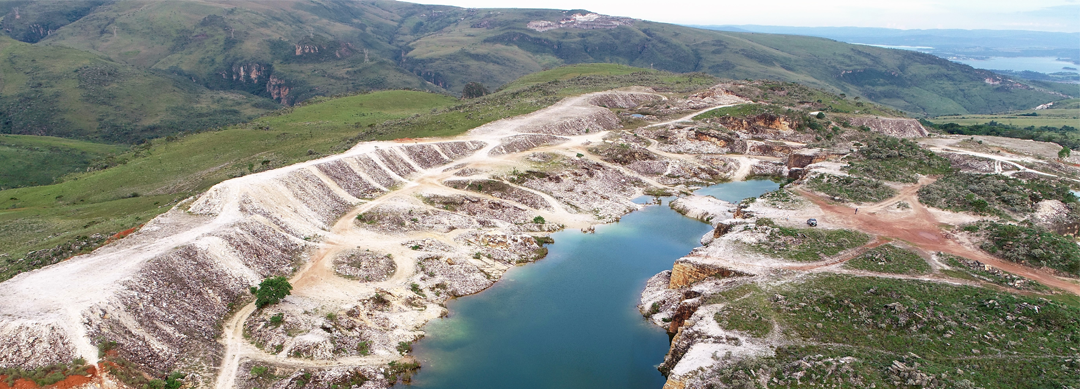
Closed mining pits present an excellent opportunity to be converted into pumped-storage hydropower plants, particularly in the case of large mining operations that have been active for many years and contain multiple pits at different depths and locations. Repurposing these mining assets for power generation could potentially address both challenges by providing a continued use for an operation that would otherwise be closed while also reducing the impact of electricity curtailment.
Implementing and operating such a solution is not simple and requires extensive technical and economic feasibility studies. In addition to all the operational infrastructure required to convert the pits into a power plant, it is also necessary to assess the location factor. Is there surplus electricity on the grid? Is there sufficient grid capacity to transmit and make use of that electricity? Are the existing structures technically suitable for hosting a reservoir?
The questions and complexities are significant, matching the scale of the problems they seek to address. But there is no doubt that this is a topic that deserves close attention, since the uncertainties of the future require concrete, well-targeted and bold action.
*This text does not necessarily reflect the views of the CCBC and is the sole responsibility of the author.