At the 5th Diversity, Equity and Inclusion Forum, experts argue that initiatives on the topic should improve compensation and corporate leadership
By Pedro Augusto
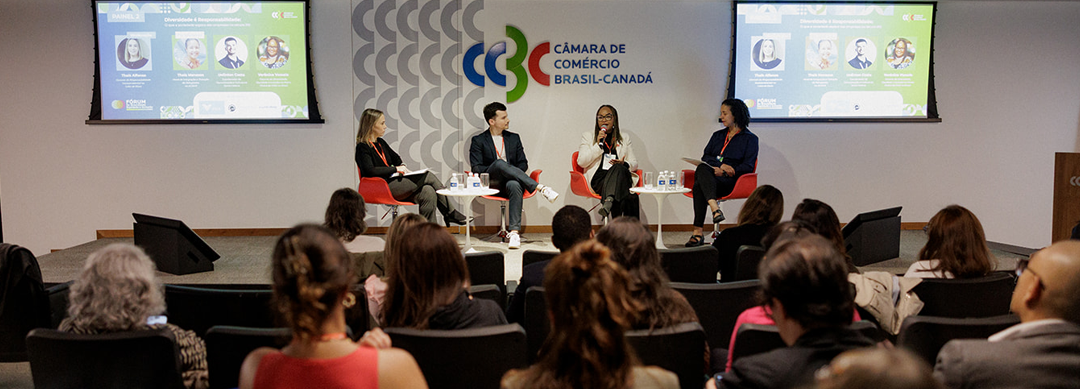
Policies, committees and codes of conduct focused on diversity are already part of the routine at many companies. What is still missing is bringing these commitments to where decisions are actually made: salaries, promotions, leadership positions and budgets. This was the central message of the 5th Diversity, Equity and Inclusion Forum of the Chamber of Commerce Brazil-Canada (CCBC), held on September 24 at the organization’s auditorium in São Paulo.
At the opening, Caio Magri, CEO of Instituto Ethos, acknowledged that organizations have made progress in creating structures, but still struggle to turn discourse into compensation, professional development and access to leadership positions. “The question is no longer whether companies should invest in diversity, but how to transform diversity into management, equity into results and inclusion into structural change,” he said. In his view, this requires targets, budgets, performance evaluations and changes to leadership compensation itself.
As host of the event, CCBC President Hilton Nascimento reinforced the message. “Diversity, equity, inclusion and social responsibility need to stop being mere intentions and take center stage in corporate decision-making,” he said.
Policies beyond HR
Amid the retreat from the diversity agenda in parts of the market, Uelinton Costa, Communications and Culture Coordinator at Santa Helena Alimentos, advocates moving these initiatives beyond the isolation of the Human Resources department. “One of the main ways to make diversity and inclusion an inherent part of a company’s culture is to place it as a component of the strategic organizational structure,” he said. Based on the experience of the Plural program, created by the company in 2023, he recommends monitoring indicators that show the impact of these initiatives on the business, which can help engage leadership.
The use of data was also addressed by Rafaela Silva, Business Development Manager at Genetec Brasil. According to her, companies already monitor various business indicators but still make limited use of these tools to identify inequalities. “What companies see is a snapshot of something,” she said. She also warned that technology and artificial intelligence can reproduce biases and therefore need to undergo assessments.
For Grácia Fragalá, Vice President of the Brazilian Association for Quality of Life (ABQV), the agenda needs to reach senior leadership and boards, precisely where the main bottleneck lies. “Two things are missing: leadership support and budget. One is a consequence of the other,” she said.
Refugees: far beyond vulnerability
In the discussion on refugees, Thaís Menezes, Head of Refugee Protection and Integration at UNHCR (United Nations High Commissioner for Refugees), pointed out that some of the barriers begin with the narrative surrounding these people, which often portrays them solely through the lens of vulnerability rather than the skills they bring. “These people have capabilities, experiences and expertise that make significant contributions to the countries where they arrive,” she said.
As an example of the gains in innovation and productivity, she cited the arrival of Venezuelans in Brazil. Among them were petroleum engineers, at a time when the country needed precisely this expertise.
The Chamber of Commerce Brazil-Canada’s Diversity, Equity and Inclusion Forum also featured the participation of Joanne Lemay, Consul General of Canada in São Paulo. The event was sponsored by Vale Base Metals at the Gold level, and by Lundin Mining, BRP and Maneira Advogados at the Bronze level.